
Clinical research training is often the best entry point when joining a project team, a sponsor, or an investigator site for the first time. Phase I trial, sponsor, CTIS, informed consent, monitoring… These terms come up constantly, yet few learning paths explain, step by step, how a trial is actually run. The good news: you don’t need fifteen years of experience to grasp the fundamentals and become operational quickly.
Why Take Clinical Research Training When You’re Starting Out?
Clinical research covers all studies conducted on volunteers, patients, or healthy participants to assess the efficacy and safety of a medicine, a medical device, or a new care strategy. Unlike preclinical research, carried out in a laboratory or on animal models, it directly involves human participants, within a tightly regulated framework, with a precise protocol, an ethics committee, and a prior regulatory authorisation.
For a beginner, the difficulty isn’t grasping the general objective — testing a treatment — but understanding who does what: sponsor, investigator, clinical research associate (CRA), clinical trial technician, competent authority. This is exactly what solid clinical research training should clarify from day one.
The Regulatory Framework to Know Before Clinical Research Training
In the European Union, clinical trials on medicines are governed by Regulation (EU) No 536/2014, and every trial authorisation now runs through the Clinical Trials Information System (CTIS), the single EU-wide portal managed by the European Medicines Agency. On top of this sits ICH E6 Good Clinical Practice, the international ethical and scientific quality standard for designing, conducting, and reporting trials involving human participants.
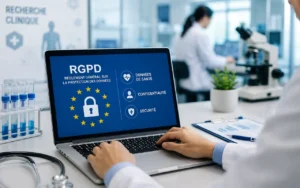
Add to this the protection of participants’ personal data: as soon as a clinical trial collects health data, GDPR applies with particular rigor. Understanding how trial authorisation, ethics committee approval, and data-protection compliance fit together is exactly the kind of thing a well-designed clinical research training program should untangle, rather than leaving learners to work it out from raw legal texts.
The Roles a Clinical Research Training Helps You Understand
A clinical trial brings together a chain of complementary roles: the sponsor carries the study legally and financially, the investigator follows patients on site, the clinical research associate monitors compliance with the protocol, and the clinical trial technician handles the day-to-day logistics and administration at the site. The CRA role in particular is often the natural entry point into the sector, as described in this overview of the clinical research associate career path. A good clinical research training course helps you discover these roles before committing to a specialisation.
Where to Start Your Clinical Research Training?
For a beginner, the ideal path follows three steps. First, build the vocabulary and map out who the key players are, without drowning in raw regulatory text. Second, understand how a trial unfolds from start to finish: protocol design, patient recruitment, monitoring, vigilance, and publication of results. Third, get familiar with the major frameworks that shape the sector — the EU regulation, ICH-GCP, and data protection rules — without trying to master everything on day one.
That’s exactly the point of short, focused clinical research training: giving you the essential landmarks in a single day, rather than spreading theory across several weeks.
Our One-Day Clinical Research Training
For BluePharm, our one-day clinical research training is designed for people discovering the sector: newcomers at a CRO, a pharmaceutical company, a hospital site, or professionals changing careers. The program mixes theory and hands-on case studies to cover, in a single session, the fundamentals of the sector, the key stages of a trial, the role of each stakeholder, and the most common regulatory pitfalls.
This training, eligible for funding through professional development schemes, is delivered by instructors with hands-on field experience, using concrete examples drawn from real projects. The goal isn’t to turn beginners into experts in one day, but to give everyone a clear picture of how a clinical trial works — enough to be operational in their role and to continue, afterwards, with more specialised modules.
Clinical Research Training: The Starting Point
Starting out in clinical research without any landmarks can feel intimidating, given the dense regulatory framework, the number of stakeholders involved, and the technical vocabulary. But with focused, one-day clinical research training, it’s entirely possible to acquire the essential foundations and build confidence quickly. This is the starting point we offer to every beginner looking to understand, structure, and secure their entry into this fascinating field.
Want to learn more about our one-day clinical research training for beginners? Contact our team to find out about upcoming sessions and funding options.
BluePharm offers this one-day module as part of its Qualiopi-certified training catalogue, alongside more specialised sessions to support your professional development across the full clinical research journey.