
The rise of medical device geopolitics
Medical device geopolitics has emerged as a key driver of competitiveness and healthcare security.
Amid trade tensions, strategic dependencies, and efforts to relocate production, the European medtech industry must learn to navigate a more volatile global environment.
For manufacturers, authorized representatives, and regulatory operators, the question is no longer if geopolitics will have an impact — but how to anticipate and manage it without compromising compliance, vigilance, and clinical research.
Medical devices geopolitics : tense global environment
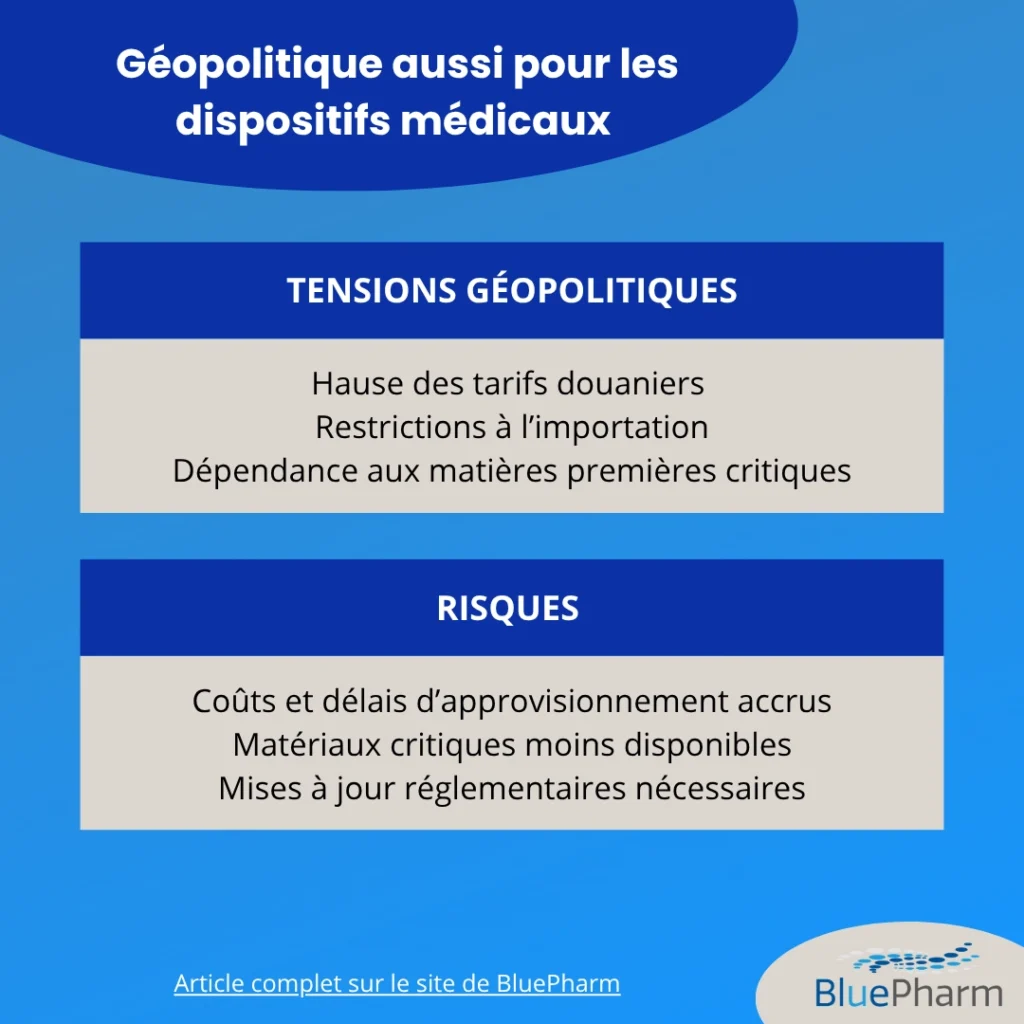
Since 2024, the geopolitics of medical devices has been shaped by a series of major policy and trade decisions:
- The United States has imposed new tariffs on imported medical technologies, particularly those from Asia. (PTC)
- In response, the European Union has restricted certain Chinese devices as part of an ongoing trade dispute (Financial Times).
- Persistent supply chain disruptions continue to affect semiconductors, rare metals, and electronic components essential to connected and implantable medical devices (LMA Consulting Group).
These developments have exposed the fragility of global logistics — especially for European manufacturers dependent on Asian or U.S. suppliers.
As a result, medical device geopolitics now lies at the heart of Europe’s debate on industrial and healthcare sovereignty.
Impacts on the European medical device supply chain
1. Rising costs and production delays
New customs tariffs, import restrictions, and transportation bottlenecks have led to higher production costs and delayed deliveries.
A European manufacturer of surgical instruments or diagnostic devices must now plan for longer lead times and increased logistics costs.
This directly affects multicenter clinical trials, which depend on the timely availability of certified devices across multiple countries.
2. Dependence on critical raw materials
Many medical devices — including implants, prosthetics, sensors, and embedded software — rely on critical raw materials such as titanium, cobalt, and electronic chips.
Geopolitical tensions between the U.S. and China, combined with restrictions on Russian exports, have intensified this dependence.
The EU has responded with the Critical Raw Materials Act, aimed at securing supply chains and stimulating local production.
However, implementation will take years, and diversification efforts remain uneven across member states.
3. Regulatory and vigilance challenges
Changes in suppliers, components, or materials often require updates to a device’s technical documentation.
These adjustments can delay audits, affect CE marking compliance, and complicate post-market surveillance (PMS, PMSR, PSUR) when product performance deviates from the original specifications.
Regulatory authorities such as the European Commission and national agencies (e.g., ANSM in France) now demand enhanced component traceability and lot tracking to ensure continuous patient safety.
Clinical research under pressure
Medical device geopolitics also affects clinical research:
- European multicenter trials may be delayed if experimental or accessory devices are not delivered on time.
- Investigators may need to adapt their protocols to alternative device versions, complicating data comparability.
- Medical writers and clinical teams must integrate every component or supplier change into the technical file, clinical plan, and performance reports.
This complexity highlights the growing importance of specialized regulatory partners.
At BluePharm, we support clients by:
- Managing regulatory updates to CE technical files,
- Coordinating post-market surveillance and vigilance reports,
- Preparing PMS and PSUR documentation following supply chain modifications,
Toward European health and industrial sovereignty
The geopolitics of medical devices is driving Europe to rethink its priorities.
Facing high dependence on imported components, EU member states are focusing on three strategic objectives:
- Relocate part of the production of critical medical devices,
- Diversify suppliers and build redundant sourcing networks,
- Include flexibility clauses in contracts and technical documentation to manage disruption risks.
The goal: to create a resilient European medtech industry capable of maintaining patient safety without interruptions or performance degradation.
France has taken a proactive approach, announcing new public subsidies for the reshoring of critical device production (Le Monde).
Strategic implications for the European medtech ecosystem
- For manufacturers: geopolitical instability requires new risk management models that integrate supply chain monitoring and regulatory adaptation.
- For regulatory affairs professionals: ensuring CE conformity despite material or supplier changes becomes a key challenge.
- For clinical research organizations (CROs): cross-border coordination must include contingency planning to ensure data consistency and protocol continuity.
Ultimately, geopolitics is transforming the medtech landscape — blending industrial strategy, regulatory compliance, and public health resilience into a single continuum.
Conclusion: geopolitics as a new dimension of competitiveness
Medical device geopolitics is no longer a background factor — it is a structural element of the market.
Amid rising costs, resource dependencies, and increasing regulatory complexity, European medtech players must adopt a global, agile, and forward-looking strategy.
At BluePharm, we help partners anticipate these shifts, secure supply chains, and adapt compliance, vigilance, and clinical strategies to evolving geopolitical realities.
Our approach combines international monitoring, regulatory expertise, and proactive risk management — essential tools for remaining competitive in a world shaped by geopolitical uncertainty.