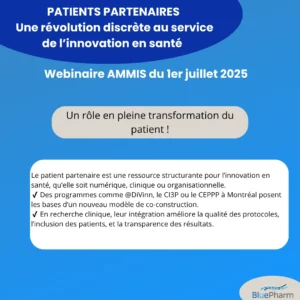

Patient Partners represent one of the most significant and quiet revolutions in healthcare innovation today. No longer confined to laboratories or scientific committees, their role is expanding into digital health projects, care organization, and clinical research. Trained and supported, these patients are becoming genuine co-actors in transforming the healthcare system.
Who Are Patient Partners?
A patient partner is not just a patient sharing their personal story or testimony. Instead, they are trained to intervene in a structured way alongside healthcare professionals, researchers, and entrepreneurs. They bring unique user expertise, a critical perspective, and the ability to co-construct innovative solutions.
Whether participating in the evaluation of a digital health tool, contributing to the design of a clinical trial protocol, or analyzing patient care pathways, the patient partner has become a key player in building useful and sustainable innovation.
Three Pioneering Initiatives in France and Beyond
Several international programs illustrate how this movement is structuring itself:
🔹 In Montreal, the Centre of Excellence on Partnership with Patients and the Public (CEPPP), affiliated with CHUM, has been a pioneer since 2010. The Quebec model, now internationally recognized, provides a clear methodology for patient-professional co-construction applied to education, research, and healthcare governance. More at: ceppp.ca
🔹 In France, the CI3P (Center for Patient and Public Partnership Innovation) at CHU Nice develops cross-training programs and supports research projects by integrating patient partners from the very beginning. This center also brings expertise in medical education by involving patients in the training of future healthcare professionals (ci3p.univ-cotedazur.fr).
🔹 In Paris, the @DiVinn program, led by AP-HP and Hôtel-Dieu, focuses on empowering patient partners to understand, test, and evaluate digital health tools. The emphasis here is on critically assessing innovations such as connected devices, platforms, or artificial intelligence solutions. Patients involved help ensure that digital health solutions are more accessible, relevant, and aligned with real-world needs.
Patient Partners in Clinical Research
Beyond digital innovation, patient partners play a growing role in clinical research, particularly in interventional studies. Their involvement can occur at several levels:
- Helping to prioritize research topics
- Assessing the feasibility of a protocol from a patient’s perspective
- Improving recruitment strategies and patient information materials
- Participating in the dissemination and valorization of study results
This approach aligns perfectly with the European Clinical Trials Regulation (EU 536/2014), which promotes transparency, ethics, and active patient participation. By integrating patient partners from the outset, sponsors—both academic and industrial—can:
- Optimize study design
- Increase inclusion and retention rates
- Strengthen the scientific relevance and legitimacy of their research
A Strategic Transformation with High Impact
For clinical trial sponsors, digital health start-ups, hospitals, and universities, involving patient partners is no longer just an ethical “plus.” It has become a strategic imperative that enables them to:
- Bridge the gap between science and real-life practice
- Increase acceptance of innovations among patients and professionals
- Meet the growing expectations of funders, regulators, and the public
By doing so, they ensure that innovations are not only scientifically valid but also socially relevant, accessible, and widely adopted.
Key Takeaways
–Patient partners are a structuring resource for health innovation—whether digital, clinical, or organizational.
-Programs like CEPPP in Montreal, CI3P in Nice, and DiVinn in Paris demonstrate the foundations of a new co-construction model.
-In clinical research, involving patient partners improves study design, patient inclusion, and result transparency.
-For stakeholders, this silent revolution is an opportunity to innovate in a more useful, humane, and sustainable way.
At the crossroads of innovation and patient experience, the rise of patient partners marks a turning point in how healthcare evolves. Their contribution is reshaping not only the design of digital tools and clinical studies but also the overall performance of health systems. For those in life sciences and healthcare, closely following this transformation is no longer optional—it is a decisive factor in the success of tomorrow’s innovations.
If you would like to receive regularly our articles, please subscribe here