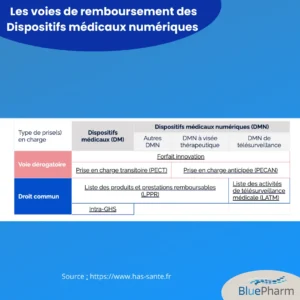

Since 2023, France has had two specific reimbursement pathways for digital medical devices (DMDs) through the national health insurance system: the List of Medical Telemonitoring Activities (LATM) and the Early Access Pathway (PECAN). In a recent statement, the Haute Autorité de Santé (HAS, the French National Health Authority) clarified its principles for the evaluation of digital medical devices. The aim is to provide manufacturers with greater clarity, improve the quality of dossiers submitted to the National Commission for the Evaluation of Medical Devices and Health Technologies (CNEDiMTS), and accelerate patient access to innovation.
Evaluation of digital medical devices: two pathways, two levels of evidence
LATM: the standard route for telemonitoring digital medical devices
LATM applies to digital medical devices designed for telemonitoring. To be included, manufacturers must demonstrate that their solution provides a clinical benefit superior to—or at least equivalent to—conventional follow-up or to an already-listed device for the same indication.
The clinical evidence required is demanding:
- Comparative clinical trials: ideally randomized, measuring objective clinical outcomes such as reduced hospitalizations, improved vital signs, or better treatment adherence.
- Real-world data: registries or observational studies confirming benefits outside of an experimental framework.
- Organizational impact: quantitative demonstration of effects on workload, coordination among professionals, and patient care pathways. HAS emphasizes that dossiers are often too descriptive and lack quantified results.
- Methodological robustness: solid protocols, relevant endpoints, and sufficiently long follow-up to prove durability of results.
In summary, LATM requires a high level of clinical evidence, very close to the traditional reimbursement standards applied to medical devices.
PECAN: an early access pathway under conditions
PECAN was created to accelerate access to innovative digital medical devices, at a stage where full-scale clinical trials are not yet finalized. It applies to both telemonitoring solutions and therapeutic DMDs. Unlike LATM, PECAN accepts a degree of clinical uncertainty, provided it is temporary and properly managed.
The expected evidence is more flexible:
- Initial clinical evidence: pilot or feasibility studies showing promising results—whether clinical markers, organizational feasibility, or patient adherence.
- Formal commitments from manufacturers: to provide additional data within defined timelines, with ongoing trials or validated protocols already underway.
- Acceptance of intermediate indicators: such as patient satisfaction, adherence rates, or early medico-economic results.
- Controlled flexibility: HAS allows partial evidence if the data generation plan is clear, structured, and credible.
In this way, PECAN allows early patient access to innovative digital medical devices, while imposing strict follow-up to confirm their clinical effectiveness and organizational value.
General principles applicable to all pathways
Beyond LATM and PECAN, HAS has revised its overall evaluation principles for digital medical devices. These principles rest on:
- Methodological rigor and scientific quality of the data.
- Ability to demonstrate a significant clinical benefit or measurable organizational improvement.
- Transparency and completeness of dossiers submitted to CNEDiMTS.
Practical guides for LATM and PECAN are now available to help manufacturers prepare strong submissions and avoid delays in the review process (LATM Guide, PECAN Guide).
Strategic stakes for manufacturers
- Anticipating the evidence strategy: the choice between LATM and PECAN depends on the clinical maturity of the digital medical device, not only on market access timing.
- Documenting organizational impact: still underdeveloped, this criterion requires reproducible methodologies to quantify effects.
- Aligning with Europe: the France–Germany agreement signed in 2025 opens the way to convergence with the German DiGA model, and eventually to joint European evaluations.
For digital health companies, mastering these requirements has become a critical condition to turn digital medical devices into reimbursed and widely adopted solutions.
BluePharm supports manufacturers on these challenges
- Expertise in clinical trial methodology and European regulatory frameworks.
- Building robust dossiers aligned with HAS expectations and adapted to each reimbursement pathway.
- Integration of clinical, organizational, and medico-economic evidence to reinforce value.
- International perspective, anticipating future European convergence, particularly with Germany.
👉 In an environment where the evaluation of digital medical devices directly determines the speed of market access, BluePharm positions itself as a key partner to secure and accelerate your projects.
Useful links
- Health at a Glance Europe 2024 – Commission européenne
- Accord franco-allemand sur l’évaluation des dispositifs médicaux numériques
- Programme européen Start-up & Scale-up Strategy