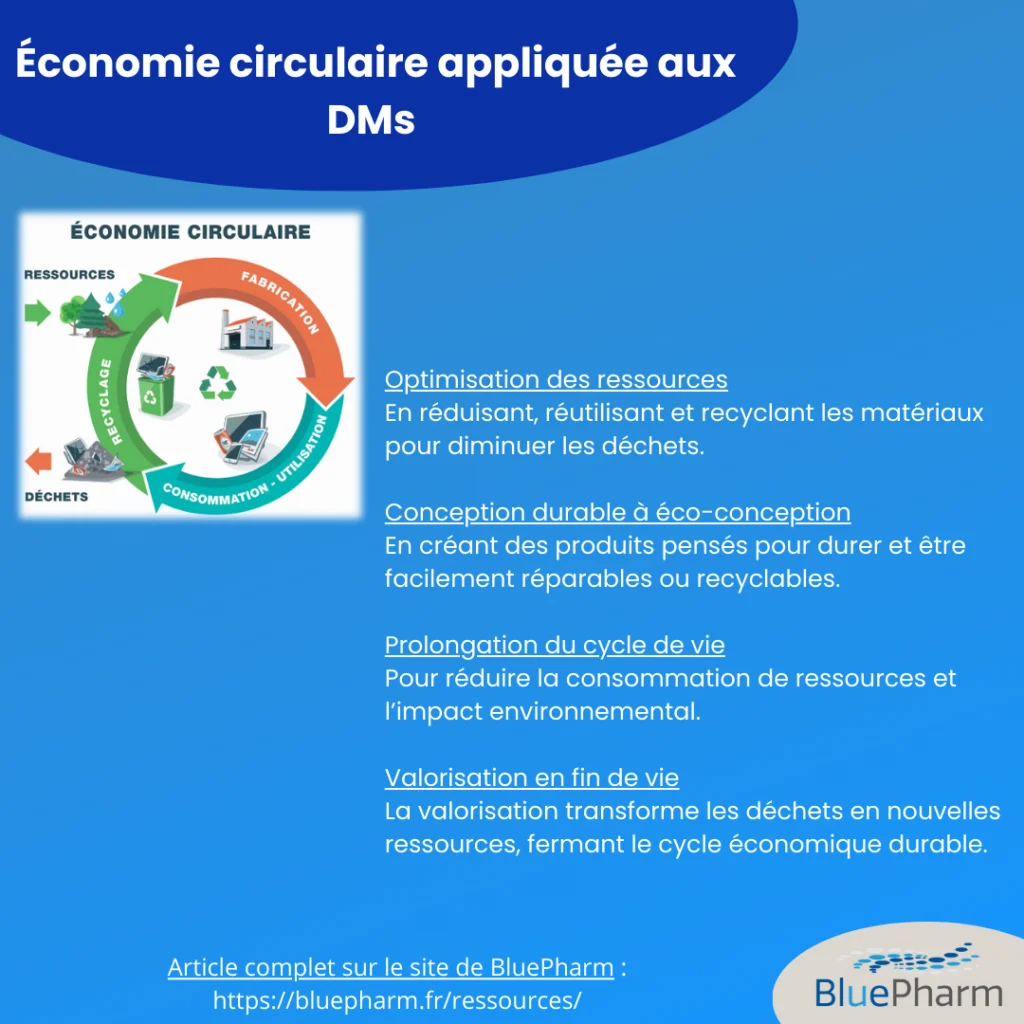

The circular economy of medical devices is now emerging as a strategic issue for European healthcare systems.
The massive increase in single-use medical devices, growing environmental pressure on hospitals, and persistent tensions in global supply chains are forcing healthcare stakeholders to rethink the traditional linear model of “produce – use – dispose”.
According to the World Health Organization, the healthcare sector accounts for approximately 4 to 5% of global greenhouse gas emissions, a significant share of which is linked to healthcare products, including medical devices.
At European level, the European Commission has fully integrated healthcare into its ecological transition strategy, notably through the Circular Economy Action Plan, which aims to reduce the environmental footprint of products while strengthening industrial resilience.
Source:
https://environment.ec.europa.eu/strategy/circular-economy_en
In France, ADEME highlights that healthcare facilities generate large volumes of waste, with an increasing proportion coming from complex medical devices. The agency encourages prevention, reuse and recycling approaches that remain fully compatible with healthcare safety requirements.
Source:
https://agirpourlatransition.ademe.fr/entreprises/conseils/professionnels-sante/nouvelles-pratiques
Circular economy of medical devices: principles and reference frameworks
The circular economy of medical devices is based on a holistic lifecycle approach, aiming to maintain the value of products and materials for as long as possible while ensuring patient safety.
It relies on several complementary levers:
- eco-design, integrating sustainability criteria from the earliest development phases;
- resource optimisation, particularly for technical plastics and critical metals;
- lifecycle extension, through maintenance, refurbishment or industrial reprocessing;
- end-of-life valorisation, via secure and traceable recycling streams.
However, these principles must be implemented within a highly regulated framework, specific to the medical device sector.
A demanding but compatible regulatory framework
Regulation (EU) 2017/745 (MDR) requires continuous demonstration of the safety and clinical performance of medical devices throughout their lifecycle.
Any circular economy of medical devices approach must therefore comply with:
- the General Safety and Performance Requirements (Annex I of the MDR),
- a quality management system compliant with ISO 13485,
- reinforced risk management (ISO 14971),
- strict requirements regarding sterilisation and biocompatibility.
The MDR explicitly recognises the reprocessing of single-use medical devices (Article 17), while leaving Member States responsible for defining national implementation conditions.
Reprocessing of single-use medical devices: a key lever of circularity
Reprocessing of single-use medical devices represents one of the main pillars of the circular economy of medical devices.
It relies on a controlled industrial process, including secure collection, thorough cleaning, functional testing, re-sterilisation, quality control and full traceability.
In France, a national pilot programme was launched in January 2026, following the Social Security Financing Act for 2024 and a decree published in the Official Journal in September 2025, under the supervision of the Ministry of Health and the ANSM.
This two-year pilot aims to assess:
- environmental and economic impacts,
- patient safety outcomes,
- organisational effects on healthcare delivery,
- acceptance by healthcare professionals.
The example of electrophysiology catheters
Cardiac electrophysiology catheters provide a concrete illustration of the potential of the circular economy of medical devices.
These complex and invasive devices have been subject to industrial reprocessing programmes for several years in multiple European countries.
Clinical studies show no clinically significant difference between new and reprocessed catheters in terms of effectiveness, signal precision or complication rates.
A life cycle assessment published in the journal Sustainability also demonstrates a significant reduction in CO₂ emissions and resource consumption for reprocessed catheters.
Source:
👉 https://www.mdpi.com/2071-1050/13/2/898
Towards a new definition of clinical performance
The circular economy of medical devices does not challenge clinical performance; rather, it broadens its definition.
The value of a medical device is no longer assessed solely through the medical act itself, but also through:
- its environmental footprint,
- its economic efficiency,
- its contribution to the long-term sustainability of healthcare systems.
The medical device of the future will increasingly be evaluated across its entire lifecycle, from design and manufacturing to use, reuse and end-of-life management.
In this perspective, the circular economy of medical devices appears as an unavoidable evolution, aligned with both European regulatory requirements and public health sustainability objectives.
Conclusion
The circular economy of medical devices represents a profound transformation of how medical technologies are designed, used and evaluated.
Far from being incompatible with regulatory constraints, it fits within existing European frameworks, provided that patient safety, clinical performance and traceability remain central.
For manufacturers, healthcare institutions and regulators alike, the challenge is now to integrate circularity as early as possible into development, clinical and regulatory strategies, while ensuring full compliance with MDR requirements.
The transition from a linear to a circular model is not only an environmental necessity, but also a strategic lever for resilience, innovation and sustainability in European healthcare systems.
See article on the same subject: Sustainability of medical devices: what impact on clinical evaluation?, Sustainable development of medical devices: an unavoidable challenge for healthcare systems
If you would like to receive regularly our articles, please subscribe here.