
Since the entry into force of the European regulations MDR (2017/745) and IVDR (2017/746), manufacturers of medical devices and in vitro diagnostics (IVDs) have faced stricter certification and clinical evaluation requirements. While these rules aim to strengthen patient safety, they also have a harmful side effect: orphan medical devices are at risk of disappearing from the European market.
These devices, often designed for rare diseases or very small patient populations, are essential for precision medicine and continuity of care. Yet, due to regulatory complexity and limited resources, they could become the forgotten casualties of Europe’s health innovation reform.
What are orphan medical devices?
An orphan medical device is a product used for highly specific, often rare indications, where the number of patients is too small to justify conventional industrial development. Despite their limited market, their clinical value is immense: they enable treatment of severe diseases for which no therapeutic alternative exists.
Examples include: rare implants, diagnostic tests for genetic disorders, or highly specialized surgical tools.
The shock of the MDR/IVDR transition
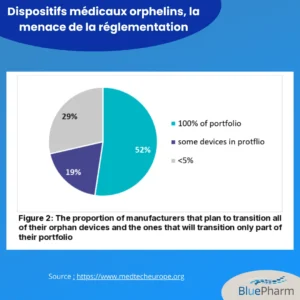
According to the MedTech Europe 2024 report:
- 53% of IVD manufacturers plan to transfer their entire portfolio under the IVDR,
- But 26% plan to transfer less than 5% of their products.
For medical devices, 52% of manufacturers expect to migrate their orphan devices under the MDR, but 29% plan to transfer less than 5%.
In short, nearly one-third of orphan devices may disappear from the European market in the coming years.
Why is the risk so high?
The main reason is the disproportionate regulatory burden introduced by the new framework.
Manufacturers must now provide clinical evidence equivalent to that required for large-market medical devices. Yet in rare diseases, conducting clinical trials is exceptionally difficult—recruitment is slow, patient populations are small, and costs are extremely high.
On top of that, certification expenses (QMS, TDA, PMS) weigh heavily on SMEs, which are often the source of the most innovative products.
The result: some companies are abandoning certification in Europe altogether, redirecting their efforts toward more predictable markets like the United States or Asia.
Clinical studies: a barrier—but also an opportunity
For orphan medical devices, clinical evaluation remains the biggest challenge. But with a strategic approach, it can also become an opportunity.
At BluePharm, we help manufacturers by:
- Designing clinical trial protocols adapted to rare diseases (smaller cohorts, flexible endpoints, observational data).
- Leveraging real-world evidence (RWE) to complement data from limited trials.
- Anticipating the expectations of notified bodies to secure timely dossier approval.
With a tailored strategy, it is possible to reduce timelines, control costs, and most importantly, preserve access to essential devices for patients with no alternative treatments.
How to prevent the loss of orphan medical devices
Industry groups and associations have proposed several key solutions:
- Accelerated or simplified procedures for devices targeting rare diseases.
- Greater recognition of observational data within clinical evaluations.
- Dedicated regulatory support for SMEs from authorities and notified bodies.
- European harmonization to avoid divergent interpretations that add unnecessary complexity.
Implementing these measures would help safeguard patient access while maintaining high standards of safety and quality.
The broader impact: innovation and public health at stake
Beyond individual products, the disappearance of orphan devices would have a broader systemic impact.
Hospitals would lose access to essential equipment, researchers would face barriers to developing niche innovations, and patients would be left without treatment options.
Moreover, this situation undermines Europe’s stated ambition to remain a global leader in medical innovation. If small, high-impact innovations can no longer navigate the MDR/IVDR framework, Europe risks falling behind in the race for technological and clinical progress.
Toward a more balanced approach
A more proportionate and pragmatic approach is urgently needed. Regulations must continue to protect patients, but they should also recognize the unique constraints of orphan medical devices and rare disease research.
Simplifying processes, acknowledging the limitations of small patient cohorts, and creating specific regulatory pathways for rare indications would preserve both innovation and equity of access.
At the heart of every orphan device is a human story—a patient who often has no other therapeutic option. Preserving these innovations means preserving hope.
Useful links
- Full text of Regulation (EU) 2017/745 – Medical Devices (MDR)
- Full text of Regulation (EU) 2017/746 – In Vitro Diagnostics (IVDR)
- MedTech Europe 2024 – IVDR & MDR Survey Results
- European Commission – Medical Devices Sector
- EMA – Clinical trials for rare diseases
- Article CE marking of medical devices: exploding delays threatening innovation in Europe