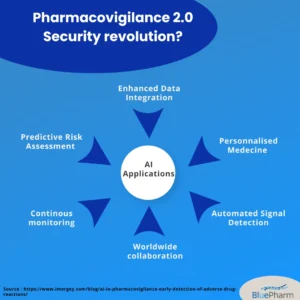

Pharmacovigilance 2.0 is no longer a futuristic concept—it is already transforming drug safety across the globe. With artificial intelligence (AI), drug monitoring has entered a new era of real-time detection, improved accuracy, and proactive prevention. From identifying early warning signals to real-world predictive analysis, AI is fundamentally reshaping how we ensure the safety of pharmaceutical products.
Pharmacovigilance 2.0: From Passive Reporting to Predictive Safety Monitoring
Traditionally, pharmacovigilance has relied on manual reporting of adverse events—a process known to be slow, fragmented, and often incomplete. Pharmacovigilance 2.0 changes this paradigm by leveraging AI to automatically monitor diverse sources of data, including global pharmacovigilance databases like VigiBase, electronic health records (EHRs), scientific publications, and even social media.
With its ability to integrate and analyze large, complex datasets in real time, AI helps detect weak or emerging safety signals long before they escalate into full-blown public health issues. What once took weeks or months of human investigation can now be flagged and escalated within minutes using machine learning algorithms and natural language processing (NLP) tools.
Real-Time Health Data Surveillance
Modern AI-driven systems continuously ingest and process structured clinical reports, hospital records, and patient feedback. Machine learning models scan this data for abnormal patterns—such as an unexpected spike in adverse reactions—and immediately notify pharmacovigilance teams.
This kind of continuous surveillance goes beyond traditional batch processing. It supports faster, more informed decision-making and allows for earlier interventions before risks reach critical thresholds. This shift from reactive to proactive safety management significantly enhances the protection of public health.
Augmented Human Intelligence, Not a Replacement
AI in pharmacovigilance is not designed to replace experts but to support them. By automating the repetitive and time-consuming aspects of data collection and classification, AI frees up healthcare professionals and pharmacologists to focus on high-value tasks like signal validation and risk assessment.
Natural language processing plays a key role here. It can automatically read and classify reports, picking up details like “The patient experienced palpitations after taking drug X.” These insights are then passed on to human analysts for clinical evaluation. The result is a synergy between machine efficiency and expert judgment.
It’s also crucial to consider scientific impact indicators like the H5 index, publishing speed, and visibility on academic platforms like PubMed Central or Google Scholar, which further validate and support AI-generated findings.
Real-World Example: Bayer’s AI Platform
In 2024, Bayer launched an AI-powered platform in collaboration with Amazon Web Services (AWS) using the Amazon SageMaker tool. The result was a significant reduction in the time required to process adverse event reports, alongside improved identification of key safety signals.
A study published in April 2025 described a multi-center AI architecture capable of aggregating health data from multiple hospitals in real time while preserving patient confidentiality. This system integrates machine learning, NLP, and secure data sharing protocols to deliver a scalable pharmacovigilance model applicable across healthcare networks.
Ensuring Data Quality and System Reliability
The success of AI in pharmacovigilance depends on the quality of the data it processes. Biased, incomplete, or outdated information can lead to inaccurate conclusions. That’s why explainability and transparency are critical. Techniques like Explainable AI (XAI), including LIME (Local Interpretable Model-Agnostic Explanations) and SHAP (SHapley Additive exPlanations), are used to interpret model decisions and build trust among regulators and healthcare professionals.
High data integrity, traceability, and model validation processes are essential to ensuring safe and responsible AI adoption in this sensitive field.
Ethical and Regulatory Frameworks
AI-driven pharmacovigilance systems must comply with strict legal and ethical guidelines. In Europe, the AI Act and GDPR set high standards for data protection, model accountability, and system transparency. Similarly, the U.S. Food and Drug Administration (FDA) has issued specific guidance for using AI in drug safety and public health surveillance.
All AI systems must be pre-validated and periodically reassessed to ensure robustness, fairness, and regulatory compliance.
Conclusion: Toward Predictive Pharmacovigilance
Pharmacovigilance 2.0 represents a significant advancement in ensuring patient safety. By enabling faster signal detection, enhanced analysis, and real-time intervention, AI is reshaping the landscape of drug safety management. The next frontier is predictive pharmacovigilance, where adverse drug reactions (ADRs) can be anticipated and prevented before they occur.
BluePharm is committed to supporting healthcare stakeholders in adopting AI technologies while ensuring full regulatory compliance and clinical efficacy.