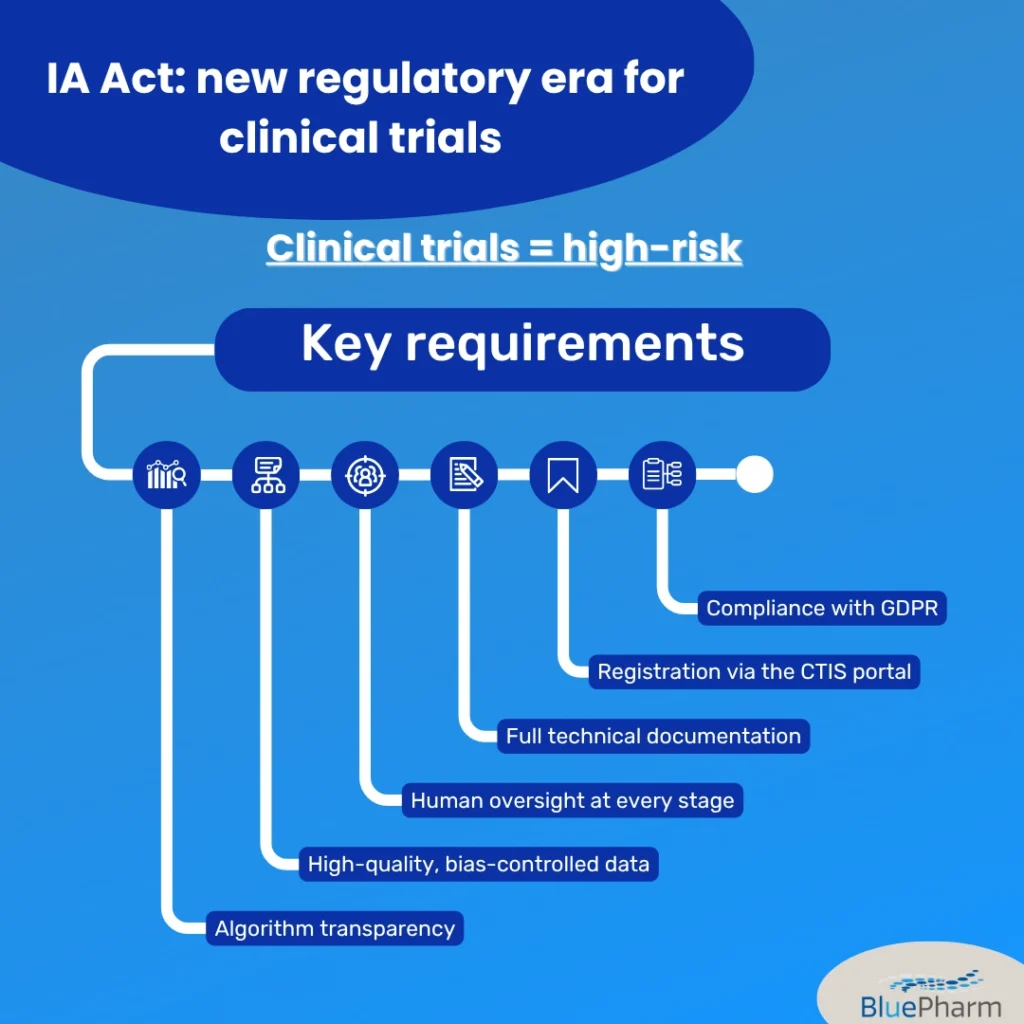

With the European Union’s adoption of the AI Act in March 2024, biomedical research stakeholders are facing a new and ambitious regulatory landscape. This legislation—the first of its kind worldwide—is designed to govern the use of artificial intelligence based on its level of risk. In the clinical trial sector, the impact is immediate: AI used for medical purposes is now categorized as a high-risk application, subject to a strict set of obligations.
The European Commission’s stated goals are double: to promote responsible innovation and to reinforce public trust in emerging technologies. To facilitate the transition, the Commission also launched the AI Pact, a voluntary commitment initiative for early adoption of good practices.
But what exactly does the AI Act require from clinical trial sponsors and developers of AI solutions in healthcare? Here are the key principles to keep in mind.
IA Act : Risk-Based Approach
One of the fundamental pillars of the AI Act is its classification system, which divides AI systems into four categories: unacceptable, high, limited, and minimal risk. Any AI system that could impact human safety, health, or fundamental rights is considered “high-risk.” This includes systems used for patient recruitment, diagnosis support, biological data analysis, and treatment prediction.
Such use cases come with clearly defined obligations by IA Act: full technical documentation, comprehensive risk management, algorithmic transparency, decision traceability, human
Reference text: IA Act – Commission européenne
New Obligations for Clinical Research
Integrating AI into a clinical research protocol now requires regulatory anticipation from the design phase. Sponsors must demonstrate that their systems meet safety standards, have been rigorously tested, and do not introduce systemic bias in medical decision-making. The source and quality of training data are under increased scrutiny, especially for machine learning–based systems.
Another critical aspect is traceability. Systems must be able to document and reconstruct decision paths—particularly when influencing participant selection or evaluating treatment tolerance. Investigators and clinicians must be able to understand the logic behind AI decisions and retain the ability to validate or correct them at any time.
Transparency is even more essential as the AI Act mandates the creation of a public EU database listing all high-risk AI systems authorized for use in the EU.
In Line with EU Regulation 536/2014 and CTIS
The AI Act does not replace existing regulations. Instead, it complements EU Regulation 536/2014, applicable since January 2025, which harmonizes clinical trial submission and evaluation across EU Member States. Any AI-based technology used in a trial must be included in the submission file via the CTIS portal (Clinical Trial Information System) with evidence of compliance with the AI Act.
Sponsors must also ensure compatibility with the General Data Protection Regulation (GDPR), particularly when handling sensitive health data. Ethical committees will be especially vigilant about the legal basis for processing data, the informed consent process, and the use of AI.
👉 To know more :
In Line with EU Regulation 536/2014 and CTIS
The AI Act represents a decisive step toward more structured and ethical innovation in healthcare. While it demands more documentation in-depth technical audits, and compliance efforts, it also offers an opportunity to strengthen quality systems, highlight responsible approaches, and gain credibility with regulatory authorities.
For pharma, medtech startups, or academic sponsors wishing to incorporate AI into their protocols, external support becomes crucial. Understanding the regulatory requirements, developing a compliance strategy, gathering appropriate documentation, and integrating all elements into CTIS submissions now requires cross-functional collaboration across regulatory, technological, and clinical domains.