
Obtaining CE marking for medical devices or in vitro diagnostics (IVDs) is a mandatory step before they can be marketed in Europe. The process requires the preparation and submission of highly detailed documentation, including:
- A quality management system (QMS) covering the entire device lifecycle,
- A technical documentation (TDA) detailing design, manufacturing, safety, and performance,
- A clinical or performance evaluation proving real benefits for patients,
- A post-market surveillance (PMS) plan to monitor incidents and ensure continuous improvement.
These requirements, reinforced by the MDR (2017/745) and IVDR (2017/746) regulations, aim to guarantee safety and reliability. However, in practice, they have led to exceptionally long certification timelines, slowing innovation and limiting patient access to new technologies.
CE marking and the central role of clinical evidence
Clinical evidence has become the cornerstone of CE certification. Manufacturers must prove that their device is safe, effective, and provides tangible clinical benefits. Yet this is also the most challenging requirement.
Two major obstacles often arise:
- Lack of clarity: Notified bodies interpret requirements for clinical data differently. What is deemed sufficient in one country may be considered inadequate in another.
- Risk of rejection: Nearly 30% of IVD manufacturers and 50% of medical device companies have experienced delayed or rejected certification due to disputed clinical evaluations.
This is where specialized players such as BluePharm can add value by:
- Building a robust Clinical Evaluation Plan (CEP) aligned with notified bodies’ expectations,
- Highlighting the scientific and medical relevance of collected data,
- Anticipating critical issues to secure market access and reduce rejection risks.
Certification timelines are exploding
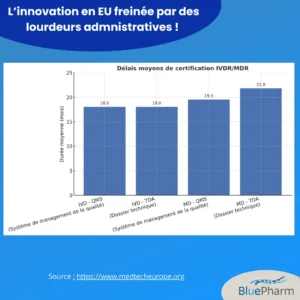
According to the MedTech Europe 2024 survey, the average time to obtain certification is:
- IVDs: around 18 months for QMS and TDA,
- Medical devices: around 19.5 months for QMS and 21.8 months for TDA.
Strikingly, more than half of this time is not spent on scientific evaluation but on administrative pre-reviews and certificate issuance procedures. Bureaucracy has thus become as heavy a burden as the technical requirements themselves.
Consequences for innovation and patients
These extended timelines are not without consequences. They create several serious challenges:
- Delayed patient access: patients must wait longer to benefit from innovative devices, whether implants, diagnostic tools, or digital health solutions.
- Discouragement for manufacturers: many companies now choose to launch their products first in the United States or Asia, where timelines are shorter and more predictable.
- Risk of shortages: existing devices also require re-certification. Delays can result in temporary or permanent unavailability on the European market.
In the background, Europe’s global competitiveness is at stake. While the EU aspires to remain a leader in health innovation, it risks becoming a secondary market if delays are not addressed.
Heavy economic consequences
Beyond market access delays, long CE marking timelines impose significant financial costs. Manufacturers must dedicate entire teams to regulatory management. According to the MedTech Europe study, nearly 90% of certification-related expenses are due to personnel costs rather than fees from notified bodies.
Every additional month of waiting translates into higher spending, delayed return on investment, and sometimes the abandonment of innovative projects. For SMEs, this financial burden can be insurmountable.
Solutions to break the deadlock
Industry players and professional associations are calling for several reforms:
- Greater harmonization of clinical evidence requirements between notified bodies,
- Increased transparency and predictability of timelines, allowing companies to plan launches more effectively,
- Structured dialogue with authorities from the early stages of dossier preparation,
- Reinforcement of notified body resources, which are currently overstretched,
- Creation of fast-track pathways for breakthrough devices or those addressing unmet medical needs.
Some experts also advocate closer alignment between clinical research and certification. The stronger the evidence from clinical trials, the smoother and faster the regulatory review process can be.
Conclusion: CE marking as a bottleneck for European competitiveness
The CE marking process for medical devices has become a true obstacle course. While essential for ensuring safety and performance, clinical evidence requirements frequently trigger delays and rejections, undermining timely innovation.
For Europe to remain competitive and attractive, urgent action is needed to:
- Clarify expectations for clinical evidence,
- Simplify administrative processes,
- Enable a faster but still secure pathway for innovation.
Without such reforms, Europe risks losing its position as a global health innovation leader to the United States and Asia—to the detriment of patients, manufacturers, and the entire healthcare ecosystem.
Useful links
- Full text of Regulation (EU) 2017/745 – MDR
- Full text of Regulation (EU) 2017/746 – IVDR
- MedTech Europe 2024 – IVDR & MDR Survey Results
- European Commission – Medical devices sector
- Article Orphan medical devices: the forgotten victims of MDR and IVDR